
Applied AI
The AI answer sounded right. Then someone opened the source.
18 October 2026 · FinAnalytic Editorial · 3 min read
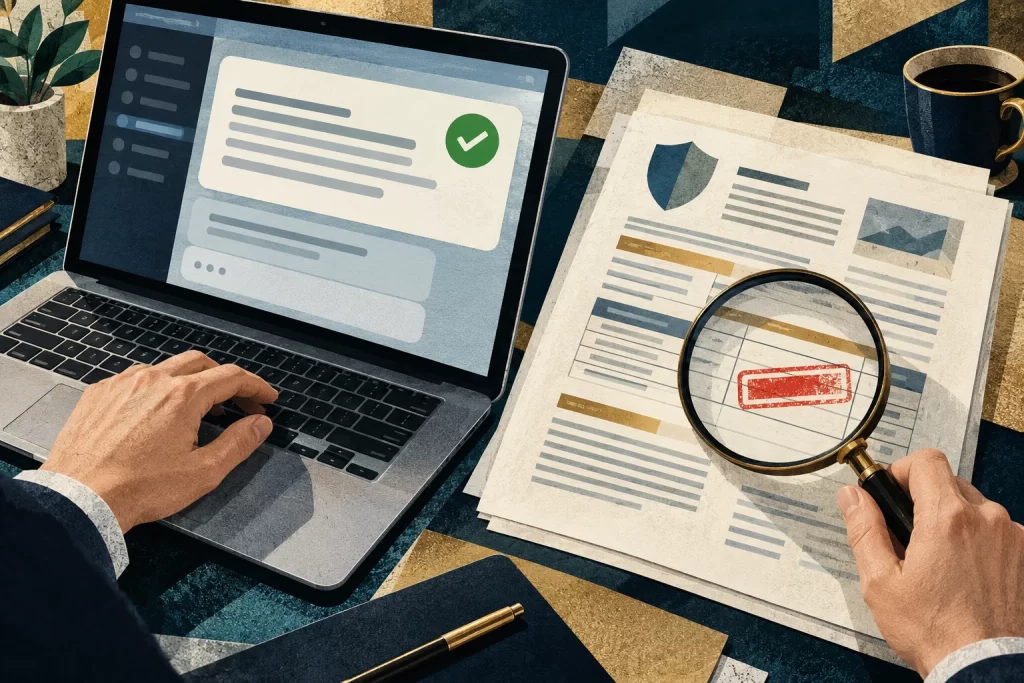
Imagine a procurement manager asking an internal AI assistant whether a supplier’s insurance is still valid. The answer arrives in seconds: yes, with a document link. She opens it. The policy expired last month.
A source link is the beginning of the check
This is an illustrative scenario, but it captures a familiar problem: an answer can look carefully researched while missing the fact that matters. The document exists. The wording sounds reasonable. The conclusion is still wrong.
NIST’s Generative AI Profile identifies confidently incorrect output as a distinct risk and recommends verifying sources and citations during testing and ongoing monitoring. The practical question for a business is whether the evidence actually supports the answer being used.
Give the reviewer a smaller job
For this supplier check, a useful response would show the insurer, policy number, expiry date and page reference. It would distinguish “a certificate was found” from “the certificate is current”. A missing renewal should produce a request for the renewal, rather than a reassuring guess.
That changes the reviewer’s job. Instead of rereading a whole file to discover what the assistant meant, the manager checks a few explicit claims against the relevant passages.
Dates deserve special attention. A folder can contain a signed agreement, an unsigned revision and an old email discussing a proposed change. The most recently uploaded file is not necessarily the document in force.
Test the awkward files first
Our suggested pilot starts with cases the team already finds difficult: a blurred scan, conflicting dates, a missing page and two suppliers with similar names. Have a knowledgeable colleague record the expected result before the assistant sees the test set.
Record different failures separately. Did the system miss the relevant document? Misread it? Use an outdated version? Draw a conclusion the text did not support? A single average accuracy number can conceal all four.
Keep a separate set of examples for the final check. Repeatedly tuning the assistant on every test case can make the demonstration look better without showing how it handles unfamiliar work.
Treat documents as evidence, not instructions
There is another trap. A document might contain text telling the assistant to ignore its rules or reveal information. OWASP describes this as indirect prompt injection when instructions arrive through external content. Finding a document should never give its author permission to control the assistant.
Test that boundary, and test access permissions too. Ask the same question as employees with different roles. A correct answer that exposes a restricted contract is still a failed result.
Decide what happens when the answer is uncertain
Before release, agree which questions the assistant may answer, which require review and which it must hand back. Measure the time to a checked result, including corrections. Keep examples of failures and rerun them after model, prompt or document changes.
Back at the procurement desk, the useful answer may be very short: “The certificate in this folder has expired. I cannot confirm current cover.” That gives the manager an action she can trust.
Sources & further reading
- NIST, Generative Artificial Intelligence Profile (AI 600-1), especially source verification and pre-deployment testing
- OWASP Gen AI Security Project, LLM01:2025 Prompt Injection
Research checked 18 October 2026. Scenarios and calculations are illustrative unless identified as reported facts.